“Be the Change”
One of my favorite quotes for an extensive part of my life has been a quote often credited to Aristotle, though I remember it more fondly from a John Green novel, and it goes like this,
“The whole is greater than the sum of its parts.” For much of my life – this is how I often viewed people, viewed society, viewed the world – a perspective I adopted early on that I never knew was actually a basis for one of the most adopted perspectives and theories in modern social work. That theory is systems theory, and when I heard my first lecture on it, I genuinely started jumping in my seat. “There’s a name for how I have seen the world?!” And there was.
Systems theory is a multi-assessment approach that looks at complex entities (humans) as a system of interconnected and never-ending parts. So, let’s break that down a bit. With the quote in mind, when viewing a person, they separately have a million elements that make up who they are – their family, their location in the world, their beliefs in the world around them – and all those components interact with a larger system outside of them. It bleeds into how they interact with their peers and their communities. And on an even larger scale, it bleeds into the economy, politics, and the way the world turns. A person is a sum of parts, but when added together – they create a whole person; a whole existence that does in fact enact change in a million ripple effects.
For example, let’s look at my life. I grew up in a very small town in southern Indiana, with a close-knit family and a community that knew me from the get-go. As I grew up, it became a cultural norm for me to embrace community, to stand up for community, as this was a value placed in my heart by my parents, but carried out in my everyday life as I grew up in a small town that did just that. So, when I moved away from Indiana, and found myself in other groups around the world, if I was unable to create a community in a new place – I felt something was missing in my own personal system. It is because I had grown up with community bleeding into every system that made me who I am – at a personal level, a civic level, and a federal level.
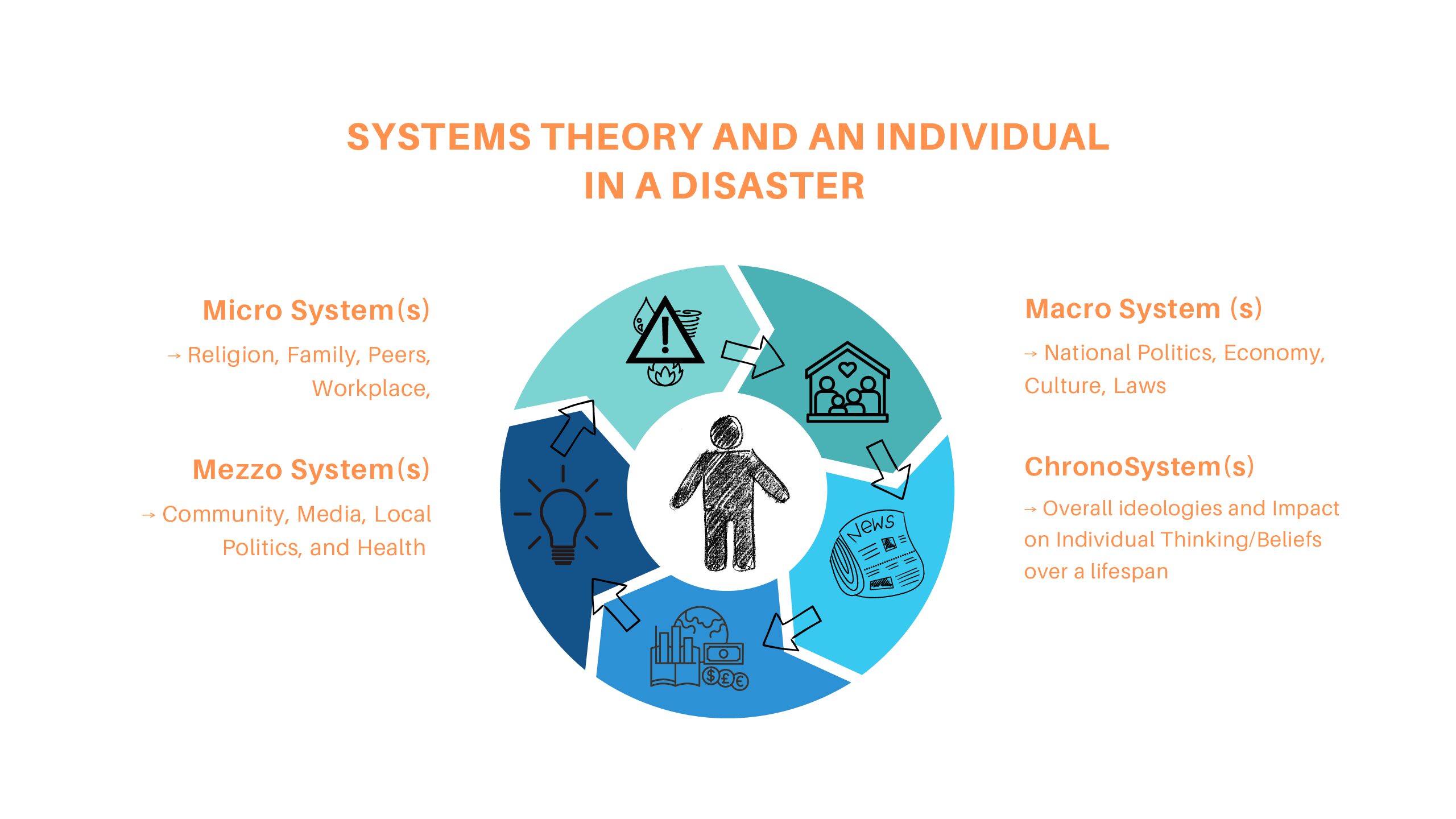
Therefore, when one of my communities was impacted by disaster – it affected me on every single level of my system. Understanding the systems theory boils down to this: no part can be completely understood in isolation from others. Change in one component will inevitably create change in the entire unit. So, when something like a natural disaster occurs, understanding it from a systems theory allows us to take a holistic approach to understanding environment and the human within that environment. Below, you will find a visual that I created to help understand this message a bit more.
Not only is understanding systems theory pivotal to social work and disaster relief as a whole, but it is also pivotal to understanding humankind. The whole will always be greater than the sum of its parts, and in every interaction, we have with one another – change is enacted every day.
So how can we make that change, a good one?
Chloe B.
Social Work Intern